
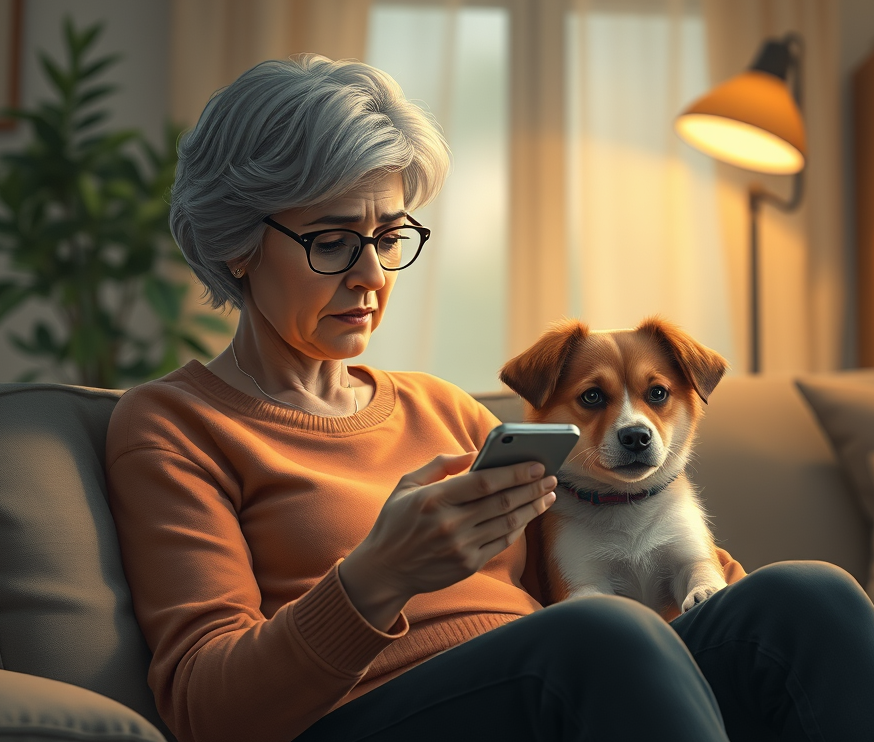
Today, everyone expects their smartphone to be capable of managing their personal and professional lives. Built-in calendars remind us of friend’s birthdays, joining a Zoom call for work is easier than ever, and sending money to your children is accomplished in just a matter of clicks. The expectations for caring for your pet are no different. Thus, any company or veterinarian able to put this into practice would have an incredible advantage in the marketplace. Animal health companies need to both empower the pet-owner through mobile services and tighten the relationship with their DVM.
According to a recent investor presentation from IDEXX, an estimated 22% of North Americans bring their pets into Veterinary Clinics as recommended — meaning 78% of the Companion Animal Diagnostics market is “underserved”[i]. If you’d prefer that figure in financial terms, here you go: Today, it’s a roughly $3 billion industry. If we were able to maximize the number of pet parents who regularly brought their pets to clinics, the industry’s value jumps to roughly $13.6 billion.
The solution isn’t about spreading awareness of the value of veterinarian services. It’s about how to inspire intrinsic drive from pet owners. We want pet owners to want to come into the clinic. Driven by millennials (29 – 44) and Gen Z (13 – 28) mobile technology has morphed from a strictly communicative technology to an empowerment tool capable of managing self, family, and work. Smartphones and the rise of social media have reshaped what the individual considers to be their priorities. Clinical visits to DVMs must become one of these priorities. This is precisely the goal of @HomeDx — empower and motivate the pet-owner to receive proactive care with the added benefit of increasing revenue for the clinic.
#1. Fecal testing
You may have seen the commercials for Cologuard. This same business model can be applied to Animal Health. Fecal tests for puppies are crucial for early parasite detection and overall health management. According to the American Animal Hospital Association, fecal tests should be conducted at least four times[ii] during a puppy’s first year. Not only do these tests help identify common intestinal parasites, but regular fecal exams can also prevent potential future health issues and the spread of zoonotic disease (parasites to humans). For those pet-parents who are too busy for regular in-clinic fecal tests — or who simply fear potential additional and unplanned costs — an easy, Cologuard-esque fecal experience would assuage those concerns.
The most recent data (June 24, 2025), Consumer Confidence has fallen by 5.4 points[iii]. Additionally, in January, Forbes[iv] reported that half of dog owners say they are very concerned or somewhat concerned about their ability to pay for an unexpected vet bill in the next three months. A Cologuard-esque service would enable predictable expenses on the consumer side, and good and proactive care for the pet.
#2. Virtual Consultation
In June, my wife found a black spot on Archie, our two-year-old labradoodle and debated whether it was a tick or a scab. I called my DVM and asked if I could send them a photo of the spot for a brief consultation. Obviously, this would save me the time of herding Archie into the car (which he doesn’t care for) and spending time at the clinic for such a small issue. If I had known from the jump that it was a tick, then maybe I would be more willing to hop in the car to get Archie some care. But the uncertainty around the spot on Archie’s back means that I would likely not be too thrilled about taking 1-2 hours out of my day for something that would likely just be a scab.
Now what if I could just take a picture?
Not only would that make my life easier and save time on the consumer side, but it would strengthen the relationship between the DMV and the pet owner. So much so, that I would likely have paid a consultation fee just to save me the hassle of going to the clinic.
Here are some further gaps I believe @HomeDx could cover:
- Image sharing: Such as the example above. For DVMs, this service could be managed through your online platform or your PIMS.
- Text messaging: For basic questions like, ‘My dog ate a jellybean, should I be worried?’
- Pain identification: Check out the Grimace Scale. Why Vets and Corporates are not jumping on this is beyond me. To see this in action, Sylvester.ai is leading the way
- Tooth/gum decay identification (Greenies)
Economics of @HomeDx.
First off, clinics should be able to cap the number of Virtual Consults, so their DVMs are not overrun with Virtual Consults (VC). Let’s say I want a VC for the issue of Archie’s tick/scab. I open the home screen application on my phone and prompted with a $20 fee. The prompt tells me that if the Vet Tech / DVM recommends an in person appointment, the $20 will be applied to the visit. I easily pay the fee with Apple Pay, Google Pay, Venmo, Stripe, or whichever POS service I prefer. That number is completely arbitrary too — it would be left up to the clinic to decide. But the reason one includes the door fee is twofold. First, it applies value to the feature. Second, it reduces the overwhelming number of inquiries by providing a modest barrier of entry. Before I know it, I’m uploading photos of Archie’s mysterious bump and within an hour I’ve heard back from the clinic.
Whew. It’s a scab. Crisis averted. Easy, right? Would you spend $20 or would you rather manage your cat into a car and take two hours off work?
Now for the money. If Veterinarians assign a single Vet Tech just 1 hour to handle the 20 inquiries (the Vet can cap the number of requests in our hypothetical scenario), the clinic’s overly-simplified economics look like this:
(20 inquiries x $20/inquiry) – (1hr of a Vet Tech labor at ~$25hr) = $475 profit per hour
Not bad.
The @HomeDx market is insanely untapped while innovators continue to get off the ground. Increasing the ease of mobile services would be a significant step to the total addressable market of inconsistent customers. Once customers see the value of engaging their veterinarian from home, the expansion of these services will only rise.
What do you think? How off am I or what have I missed?
[i] https://www.idexx.com/media/filer_public/55/c4/55c4a4f0-21a1-4181-9fec-ebebbdb1627b/2024-08-15-idexx-investor-day.pdf.
[ii] https://www.aaha.org/resources/what-is-your-pets-poop-telling-you/#:~:text=Even%20if%20your%20pet%20seems%20healthy%2C%20the,and%20twice%20a%20year%20as%20an%20adult.
[iii] https://www.conference-board.org/topics/consumer-confidence/
[iv] https://www.forbes.com/advisor/pet-insurance/pet-ownership-statistics/
 baseunitedconsulting.com
Leave a comment